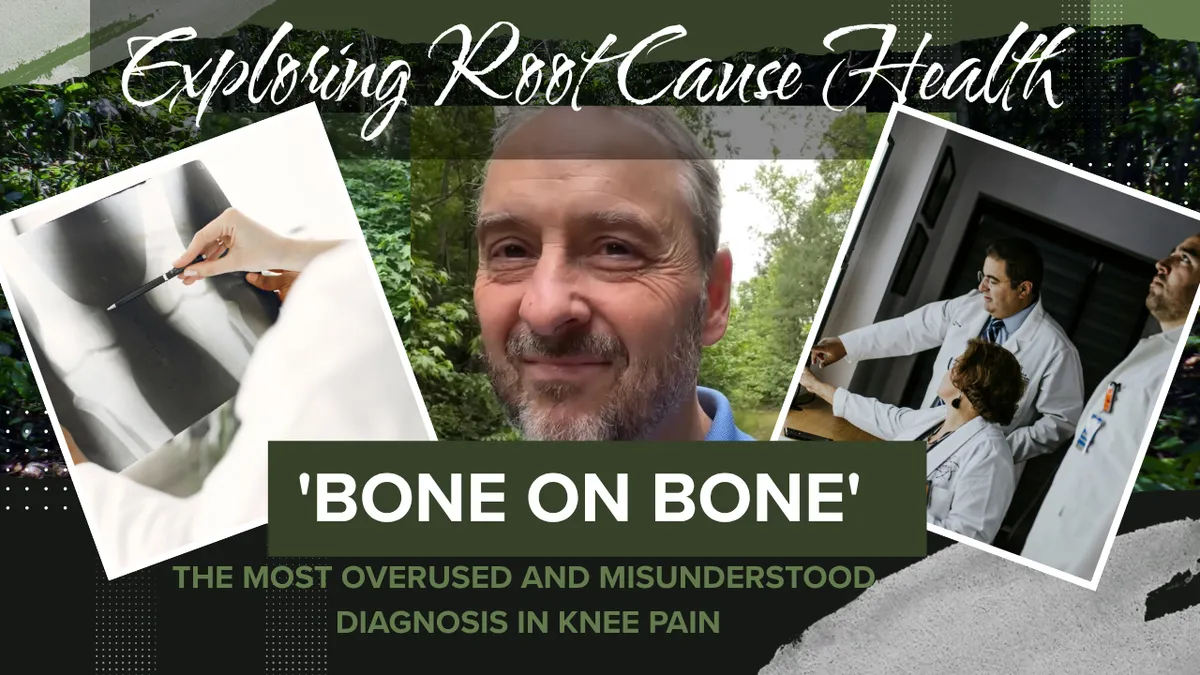
'Bone on Bone' - The Most Overused and Misunderstood Diagnosis in Knee Pain
'Bone on Bone' - The Most Overused and Misunderstood Diagnosis in Knee Pain
Three words, that's all it took. Three words from your doctor looking at an X-ray or an MRI to change the way you think about your knee, and maybe your future forever. The words are bone on bone, and at that moment, something shifted because those words don't just describe a finding. They carry a verdict.
They carry an implication. They sound final. They sound like the end of the road. Like the body has, I don't know, used itself up, and there's nothing left to work with. Maybe your doctor followed it up with, "You're getting a knee replacement eventually." Maybe they said, "There's really nothing more we can do conservatively."[00:01:00]
Maybe nobody said anything, but the silence said it for them, right? And you walked out of that office carrying those three words like a weight you didn't have before you, you walked in, right? I wanna talk to you about those three words today because research tells us a different story than the one most patients are handed in that moment.
And in those words have been shaped how you are thinking about your knee and your options. What I'm about to share may change everything. First, I want to acknowledge something. The moment you received a diagnosis like bone on bone is genuinely difficult. The pain is real. The limitation is real, and having a doctor look at an image of your joint and essentially tell you the structure is gone, that cushioning has worn away, feels [00:02:00] like confirmation of something you feared.
It looks like the most serious, most honest assessment you've received. An image doesn't lie, right? So I wanna be careful here. I'm not going to stand in front of you and tell you that cartilage, you know, the loss of cartilage is not real, or that your pain isn't real, or that the structural changes on that image don't exist.
They do. But here is the distinction that I think changes everything. A finding is not a verdict. A structural observation is not a biological sentence. An image tells you what the structure looks like at one moment in time. It does not tell you what the tissue is capable of, what the biological environment of that joint is doing, or what is actually driving your pain.
And the moment bone on bone is used as a [00:03:00] full stop, as the end of the investigation rather than one finding within a larger picture, that's where patients get failed. Because there's so much with that image that it's not telling you. And that gap between what the image shows and what is actually happening biologically is where the real story of your knee lives Let's start with what the term actually means in plain language. Your knee joint is where the bottom of your thigh bone, the femur, meets the top of your shin bone, the tibia. Right, in a healthy knee, the surfaces of both bones where they meet are covered by a layer of articular cartilage, a smooth, resilient tissue that acts as a shock absorber and allows the joint to move with minimal friction
[00:04:00] When that cartilage wears down significantly throughout, you know, throughout the years of degeneration, mechanical stress, inflammation, metabolic changes, or a combination of all of them, right? The space between those bones on an X-ray appears narrowed. In severe cases, the bones appear to be in contact with each other.
That's the image your doctor is looking at when they say bone on bone. Now, here's what that image is showing you. The thickness or lack thereof of the cartilage layer as reflected in a joint space on a two-dimensional X-ray, and here's what the image is not showing you. It is not showing you the biological activity of the remaining tissue.
It is not showing you the cellular environment of the joint, whether the cells present are in a state of active degeneration or whether there is any regenerative capacity showing. [00:05:00] It is not showing you the state of circulation to the joint. It's not showing you the inflammatory signaling environment. It is not showing you the nerve sensitivity pattern that is largely responsible for how much pain you're actually experiencing. The X-ray is a structural snapshot. It's looking at the architecture. It tells you what the building looks like. It does not tell you whether the building can be renovated Or what the electrical system is doing, or whether the foundation has more integrity than it appears from the outside. And in medicine, particularly the m- musculoskeletal medicine, right, we have a dangerous habit of treating the architectural snapshot as if it tells the complete story. It doesn't, not even close.
Now, I want to share something with you that I think is one of the most important and underappreciated bodies of research in the entire field of knee [00:06:00] pain, and it is research that directly challenges the authority we give to the imaging findings in determining what the patient should experience.
Multiple well-designed studies, right, and there are several of them, but multiple have looked at the relationship between what shows up on knee pain imaging and the pain patients actually experience
And the findings are, if you're carrying the weight of a bone-on-bone diagnosis, genuinely remarkable. Here is what the research consistently shows. The correlation between the severity of structural findings on imaging and the level of pain a patient experiences is surprisingly weak. Let me be clear, studies have found significant populations of people, adults, often older adults, who have severe osteoarthritic changes on [00:07:00] imaging, including findings that would be described as
bone on bone who report little to no pain. They're walking, functioning, living their lives, and their X-rays look structurally like someone who should be in significant pain. Conversely, there are patients who have relatively mild structural changes on imaging who are in severe debilitating pain that significantly limits their function. One particularly well-known study published in a leading rheumatology journal found that the majority of people with radiographic evidence of knee osteoarthritis, in other words, it showed structural changes, the majority did not report significant knee pain. The structural finding was present. The pain experience was not.
What does this tell us? It tells us that structure is not destiny. While the amount of cartilage visible on an [00:08:00] X-ray is important, it's one variable in a complex biological equation. It's not the determining factor of pain or function. So what is determining the pain experience, if not just the structural damage?
The biological environment of the joint, the inflammatory signaling, the state of nerve endings within the joint tissue, the degree of central sensitization, right? The way the nervous system has been trained over years of chronic pain to amplify signals from the knee. The metabolic health of the surrounding tissue, the circulation, the cell's activity, all of these things, right?
None of which show up on an X-ray, are profoundly influencing what you feel and how you function, and all of them are, to varying degrees, addressable. That's the optimism. That's what the science is pointing toward. The [00:09:00] structure may look the way it looks,
But the biology, the living, responsive, dynamic biology of that joint is a different conversation entirely. And it's the conversation that almost never happens after they discuss bone on bone. Let me go a, a little bit deeper because I want you to understand specifically what is happening inside the chronically painful knee that imaging simply cannot capture. The first thing an X-ray doesn't show you is the biological activity of the remaining tissue.
Even in a knee with significant cartilage loss, there is remaining tissue. There are cells, And those cells exist on a spectrum from highly dysfunctional and actively degenerating Two, in some cases, showing capacity for response under the right conditions. The image shows how much cartilage there is, [00:10:00] right? It tells you nothing about what that tissue is doing biologically or what it might respond to. The second thing imaging doesn't show is the inflammatory environment. A joint that is bathed in chronic inflammatory signaling molecules, s- cytokines, proteases, inflammatory mediators, is a joint in which every biological process is being suppressed and disrupted.
That environment is, invisible on im- imaging, right? But it is profoundly relevant to both the pain experience and the tissue's capacity to heal, to respond to treatment. The third thing imaging doesn't show is a state of nerve tissue within and around the joint. Chronic pain changes nerves. A knee that has been sending pain signals for years, even after the original injury or degenerating has stabilized, is a knee whose nerve tissue has undergone real changes.
The nerve endings within the joint capsule and the [00:11:00] surrounding tissue becomes sensitized. They fire more easily, more intensely in response to stimuli that would not have triggered pain in the healthy joint, right? This is called Peripheral sensitization, and it is a chronic driver of chronic knee pain that has absolutely nothing to do with what shows up on an X-ray. And beyond that, there is a central sensing process by which the brain and the spinal cord, after prolonged chronic pain input, essentially recalibrate the pain processing system to be more sensitive, right? The volume gets turned up at the neurological level. This means that the pain you feel is not only a reflection of what is happening in the knee, it's also a reflection of what has to happen to your nervous system's processing of that signal over time.
None of this is on X-ray. None of this is captured in the phrase bone on bone, And none of this is addressed by knee replacement, [00:12:00] Which is in part why a meaningful percentage of replacement patients continue to have pain after surgery. Because the surgery addressed the structural finding, But the nerve sensing system, the inflammatory environment, the biological terrain of the tissue, those things didn't go away with the old joint.
The imaging is one chapter of the story, and we have been making life-altering decisions based on one chapter of a much bigger book. I want to spend a moment on something that doesn't get enough attention, the power of language in medicine, and specifically what the phrase bone on bone does to a patient.
When you hear those words delivered by authority, accompanied by an image in a clinical setting, your brain does something very human. It forms a mental model, and the mental model that bone on bone generates is one of irreversibility, [00:13:00] of finality, a structure so compromised that the biological rules no longer apply in the same way.
And here's why that matters beyond just psychology. The belief that nothing can help is not neutral. It changes behavior. It changes how people move, how much they move, how seriously they invest in treatment, how open they are to alternatives. It creates a self-fulfilling dimension to the prognosis.
Patients who are told bone on bone, you'll need a replacement, often stop looking. They stop asking questions. They stop pursuing options because the authority figure or the image told them the conclusion. And in doing so, they may be abandoning biological terrain that still has real capacity, real potential.
And the data point that they were given was [00:14:00] interpreted as the whole story. You know, it's seen-- I've seen patients who were told their knee was beyond conservative help, beyond repair. Patients carrying the bone on bone label for years respond to approaches that worked at the biological level of the joint in ways that genuinely surprised them.
Not because cartilage magically regenerated to the thickness of a 20-year-old's, but because the biological environment shifted, the inflammatory cycle changed, the tissue that was present began functioning differently. The pain experience changed, sometimes dramatically. The language we use in medicine shapes The reality patients inhabit. And bone on bone as a final verdict rather than as one structural finding among many biological variables, as language that closes doors that may not need to be closed.
So here is the [00:15:00] reframe I want you to carry with you from this video. Bone on bone is a structural description. It is not a biological sentence. It tells you something meaningful about the architecture of your joint, and that information matters, but it does not tell you what the biology of that joint is doing, what it's capable of responding to, or what your pain experience will be in six months.
Or if the right inputs are applied to that biological environment, the question that should follow every bone on bone diagnosis, the question that almost never gets asked, is what is the biological environment of this joint? And what would it take to shift it? What is driving the chronic inflammation that is both causing the pain and suppressing the tissue's capacity to repair?
What is the state of circulation and cellular activity in the remaining tissue? [00:16:00] What is the degree of nerve sensitization contributing to the pain experience and can, that can be addressed? What metabolic and systemic factors are feeding the degeneration environment, and can that be modified? These questions don't make the structural finding disappear They don't promise that every knee can be restored You know, honesty matters here and I will always choose honesty over false hope.
But they open a door, A real biology-grounded door that has the phrase bone on bone routinely closes before anyone has a chance to look through it. Your knee is living tissue. Even in its most compromised state, it is not inert. It is not a rock. It is a biological system that is responding constantly, dynamically to the inputs that it receives.[00:17:00]
Change the inputs, change the biological environment, and the response of that tissue may surprise you. That is not wishful thinking. That is the direction the science is pointing, and it is the foundation of an entirely different approach to chronic knee care. One that starts not with how do we manage what's left, but with what does this biological system need to function differently than it's functioning right now?
That question changes everything, and it starts with, you know, refusing to let three words be the end of the conversation. So here's what I want you to take away from today. Bone on bone is one of the most emotionally heavy and least complete descriptions in musculoskeletal structure. It says nothing about biology, and the research is remarkably [00:18:00] clear that structural findings on imaging correlate poorly with pain experience, meaning that the image is not telling the whole story, and the whole story is where the real possibility lives.
What X-rays don't show, the inflammatory environment, right? The cellular activity, the nerve - sensitivity, the biological terrain of the joint.
These are the variables that most powerfully influence what you feel and what you can recover from. And these are the variables that a genuinely comprehensive approach to knee care must address. You're not your X-ray, your knee is not a verdict, and bone on bone is not the last word unless you allow it to be. In the next video, we're going to start shifting from what's wrong with the conventional approach to what a fundamentally different way of thinking about knee healing actually looks [00:19:00] like.
The concept of biological restoration, why the body has more capacity than it's been really given credit for, and what has to happen inside the joint for that capacity to be unlocked. This is where the series starts to turn, and I think you're going to find it worth staying for. If you know someone who has been handed a bone-on-bone diagnosis and told there's nothing left to do, please share this video.
That person deserves to hear a different conversation before they make an irreversible decision. Subscribe so you don't miss what's coming. I'm Dr. Bob Millham at Wake Integrative Health, where a diagnosis is never the end of the investigation. It's just the beginning.
