
Read Our Latest Blogs
Learn the latest on a variety of health topics
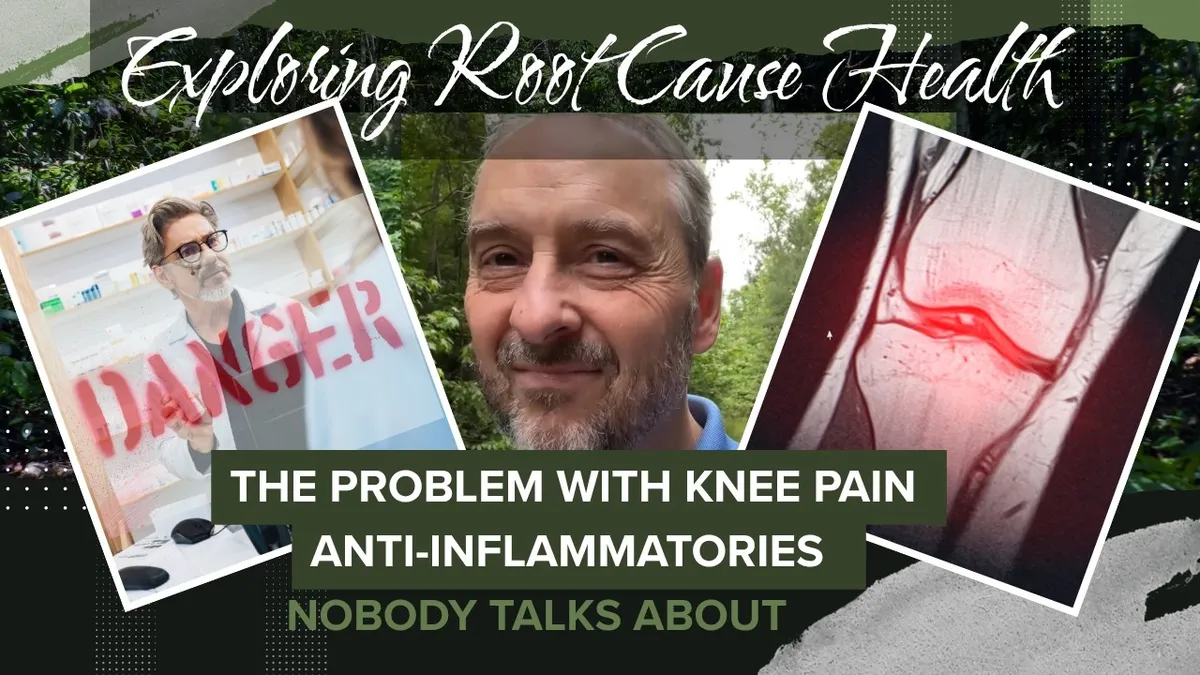
The Problem With Knee Pain Anti-Inflammatories Nobody Talks About
The Problem with Knee Pain Anti-inflammatories
[00:00:00]
There's a moment that happens for a lot of people with chronic knee pain, and if this is you, you'll recognize it immediately. You wake up in the morning. Before you even get out of bed, you know your knee is going to be a, a problem today, right? So before breakfast, before coffee, sometimes before you're even fully awake , you reach for the ibuprofen, or the naproxen, or whatever anti-inflammatory has become part of your daily routine, and it takes the edge off.
Enough to get through the day, enough to do what you need to do, so you keep doing it. Days become weeks. Weeks become months. Months, for some people, become years. And here's what [00:01:00] nobody in that picture ever stops to ask: What is happening inside your body, inside your knee, inside your gut, inside your cardiovascular system while you're doing this every single day?
And more importantly, is the thing that you're taking to manage your knee pain actually making your knee worse? Because the research has something very uncomfortable to say about that, and I think you deserve to hear it. Let me start where, where I always start, with what's true and fair.
Anti-inflammatory medications, NSAIDs, which stands for nonsteroidal anti-inflammatory drugs, things like ibuprofen, naproxen- You know, they work for acute pain, for short-term inflammation, following an injury, for getting through a difficult day. They provide real, measurable relief. I'm not gonna [00:02:00] pretend otherwise.
And the reason people reach for them daily isn't weakness or laziness. It's because they're dealing with real pain that limits real life. They can't play with their grandchildren. They can't walk the golf course. They can't get through the workday without wincing, and the pill in the bottle provides enough relief to function.
That is completely understandable, and I want you to hear that before I get into anything else today. But here's the distinction that I need you to fully hold or grasp. Relief is not the same as resolution. Functioning despite a problem is not the same as a problem actually getting better. In the case of chronic knee pain treated with daily anti-inflammatories, the evidence increasingly suggests that the relief you're getting may be coming at a [00:03:00] biological cost that is silently compounding the very problem you're trying to manage.
That's not a fringe opinion. That's what the research shows, and it's a conversation that almost never happens in the 15 minutes you spend with your doctor. To understand the problem, you need to understand what these medications are actually doing in your body, not at the level of, "they reduce inflammation", but at the level of how they do it, right?
And what that actually means. NSAIDs work by blocking a specific group of enzymes called COX enzymes. COX is cyclooxygenase enzymes, specifically COX-1 and COX-2. These enzymes are, well, they're responsible for producing molecules called prostaglandins. And prostaglandins do several things in the body.
They m- [00:04:00] mediate inflammation, they sensitize nerve endings to pain, and they also perform a number of other critical biological functions that have nothing to do with inflammation. When you take an NSAID, you're blocking the production of prostaglandins broadly. This reduces the inflammatory cycle, which reduces pain. That's the mechanism, and it's effective.
But here's what makes this important. Prostaglandins are not just inflammation molecules. They are r- regulatory molecules. They play, they play a role in protecting the lining of your gut. They play a role in regulating blood flow to your kidneys. They play a role in cardiovascular function. And critically for your knee, they play a role in the repair and maintenance of cartilage.
When you block COX enzymes broadly, you're not just selectively turning off inflammation in your knee. You're suppressing a signaling system that your body [00:05:00] uses for multiple essential biological functions simultaneously. And when you do that every day for months or even years, the downstream effects extend well beyond the knee.
This is the part nobody explains when they tell you to take two ibuprofen and call me if it gets worse. Now, I want to address something that I think is one of the most damaging misconceptions in modern healthcare, and it's one of ... that's really been thoroughly embedded in the way we talk about pain and disease, that most people have never even thought to question it the idea that inflammation is the actual underlying problem. We talk about it as if it's a malfunction, as if the body had, for some inexplicable reason, decided to attack itself, create pain, and make your life miserable. And the solution is to chemically suppress that response as efficiently [00:06:00] as possible.
But that's not what inflammation is at all. Inflammation is your body's primary healing and defense response. It is sophisticated biological intelligence that has been refined over millions of years of evolution. When tissue is damaged, when there's infection, when something needs repair, inflammation is the system your body activates to deal with.
It increases blood flow to the area. It recruits repair cells. It clears out damaged tissue, and it initiates the healing cascade. Inflammation in the acute setting is not the disease. It is the cure beginning the process. Here's an analogy. I want you to think about Like imagine your city's emergency services when there's a fire the firetrucks show up, there's noise, there's disruption, there's activity that is uncomfortable, and the [00:07:00] disruption to the neighborhood is real.
But we don't call the fire department and say, "Please stop coming. You're too loud. You're blocking traffic." We understand that the disruption is the response to the problem, not the problem itself. Chronic inflammation in your knee is the fire truck that won't leave, and the right question is, why won't they leave?
What fire is still burning that keeps calling them back? Is it damaged tissue that never properly healed? Is it a metabolic environment that keeps triggering an inflammatory response? Is it a mechanical stress on tissue that doesn't have the biological resources to repair itself? Is it something more systemic, a dietary pattern, a gut issue, a metabolic dysfunction that is feeding chronic inflammatory states throughout the body? These are the questions that [00:08:00] matter. Taking an anti-inflammatory to manage chronic knee inflammation without asking these questions is exactly like calling the fire department and telling them not to come while the fire keeps burning.
Right? The neighborhood gets quieter, but the fire doesn't go out. And here's what makes chronic inflammation different from acute inflammation and why this distinction is so important. Acute inflammation resolves it, right? It does its job. It clears. Chronic inflammation is a sign that the repair process has become, well, dysregulated, that something is perpetuating the inflammatory cycle that the body cannot resolve on its own.
That perpetuating factor has an identity. It has a cause, and it can be in most cases investigated and addressed, but only if someone is looking for it. [00:09:00] And nobody is looking for it if the solution is a daily pill that makes the signal quieter.
Now let's talk about what the research actually shows happens when anti-inflammatories are used chronically for knee pain, because this is where the conversation needs to go and almost never does. First, and this one is perhaps the most ironic finding in all of musculoskeletal medicine, the studies have found that long-term NSAID use may actually accelerate cartilage breakdown in osteoarthritic joints. Let me say that again because it's worth sitting with. The most commonly recommended medication for knee arthritic pain may be, over time,
contributing
to worsening the arthritis it's being used to treat.
The mechanism relates back to what we discussed, Prostaglandins play a role in cartilage maintenance. [00:10:00] Block them chronically and you have an interference with the cellular environment that cartilage depends on to maintain itself. You also, by reducing pain, often allow people to load and stress a joint beyond what the tissue can safely tolerate. The warning signal has been turned down. The pain was telling you to protect the knee. You silenced the pain, and the knee paid the price. Second, the gut. This is one of the most well-documented side effects of chronic NSAID use, and yet most patients using them daily have never been counseled about it.
COX-1 enzymes, which NSAIDs block, are critical to producing the protective mucus lining of the stomach and the intestinal wall. When you chronically suppress COX-1, you're chronically undermining the integrity of your gut lining. This leads to gastric irritation, ulcers in some cases, and what's being more recognized in the research [00:11:00] is increased intestinal permeability or what's called, commonly called leaky gut, right? And here's why that matters for your knee specifically. A compromised gut lining allows inflammatory triggers, partially digested food particles, bacterial components to enter the bloodstream in ways they shouldn't.
This drives systemic inflammation, the same systemic inflammation that is feeding the chronic inflammatory environment in your knee. So the medication you're taking to reduce knee inflammation may be contributing to the gut dysfunction that is perpetuating the systemic inflammation that is driving the knee inflammation You are in the most literal biological sense chasing your own tail. Third, cardiovascular and kidney function, right? This is particularly relevant for older patients and those with any existing cardiovascular risk. Chronic NSAID use, particularly the [00:12:00] COX-2 selective, variety, has a well-established association with increased cardiovascular risk.
NSAIDs also reduce blood flow to the kidneys, and long-term use is associated with kidney function decline. Now, I wanna be careful here. I'm not saying that every person who takes ibuprofen for knee pain is going to develop heart disease or have kidney failure. You know, that would be irresponsible. But what I am saying is this, when a medication is used daily for months or years for a condition it does not treat, only manages, , while at the same time carrying documented risks to the gut, the cartilage, the cardiovascular system, and the kidneys, the risk-benefit calculation looks very different than when it's used for a few days following an acute injury.
That calculation is rarely done transparently in the context of chronic knee pain [00:13:00] management. The person taking ibuprofen every day deserves to know what that actually means. Most of, most of the patients who are taking it don't. So why does this happen? Why is the default recommendation for chronic knee pain at every level of the conventional system a medication that doesn't address the cause and carries significant biological costs when it's used in the long run?
The honest answer has several layers, right? The first is structural. A 15-minute appointment is not designed for the kind of investigation required to identify why a chronic problem has been inflamed for many years. It's designed for the fastest effective intervention available with the toolkit provided, right?[00:14:00]
And an NSAID prescription is fast, familiar, and provides measurable short-term relief. The second is conceptual. The conventional model treats inflammation as a condition. If inflammation is the actual disease. Anti-inflammatories are the treatment. The model doesn't naturally generate the question, what is the inflammation responding to?
Right? The third is a gap in follow-up. Nobody is systemically evaluating the chronic NSAID use in doing the- what it's doing to the gut, the cartilage, the cardiovascular system, right? The knee patient taking them daily. The 15-minute follow-up appointment asks, "Is the pain better?" Not, "What is happening to your joint tissue?
What is happening to your gut lining? What is the state of the inflammatory drivers that are [00:15:00] keeping the cycle going?" Those questions require a different model, a model that sees the, the knee not as an isolated painful structure to be managed, but as a living tissue within a whole body biological system, a system that is sending signals worth understanding, not just suppressing.
And that model changes everything about what treatment looks like. Here is the reframe I want to leave with you. Right. Anti-inflammatories are not evil. They're not the enemy. In the right context, short-term, acute, bridging something better, they have a legitimate role, but chronic daily use of anti-inflammatory medication for chronic knee pain is not a treatment.
It is a noise cancellation. It is turning down the volume on a signal that your body is [00:16:00] generating for a reason And we're doing it without ever investigating the reason. And the biological cost of that noise cancellation sustained over months and years can compound the very problem that it's masking.
The right approach asks fundamentally different questions. Why is the knee chronically inflamed in the first place? What is the perpetuating driver of this inflammation? And can it be identified and addressed? What does the biological environment of this joint need to shift from a state of chronic breakdown to a state of where repair is possible?
And how do we actually support the body's own healing intelligence rather than suppress it in a way that actually changes the trajectory of this knee? [00:17:00] Those questions don't lead to a prescription pad. They lead to an investigation, and that investigation, when it's thorough and when it's informs a genuinely comprehensive approach is where outcomes are different because you stop fighting the body's signals and you start listening to them. That shift from suppression to resolution, from management to restoration is the foundation of what root cause knee care actually looks like, and it is a fundamentally different experience than what most chronic knee pain patients have ever been offered. So here's what I want you to walk away from today. Anti-inflammatory medications provide real relief, but they do not provide resolution.
They suppress a biological signal without investigating its, its cause, and it's used chronically. The research suggests, look, [00:18:00] they may accelerate cartilage breakdown, compromise your gut integrity, and create systemic effects that feed the very inflammatory cycle they're meant to quiet. The problem with anti-inflammatories for knee pain isn't that they don't work, it's that they work just well enough to make it easy to stop asking the question that actually matters, why is the knee inflamed in the first place?
And what would it take to actually resolve that? In the next video, we're going to go even deeper into that question, because I wanna talk about what bone on bone actually means, why it may be the most overused and misunderstood phrase in knee care, and why the patients that are told that there's nothing left to work with are often carrying more possibility than they've ever been shown.
If this [00:19:00] video shifted something for you, if it made you think differently about what's in your medicine cabinet and why, then share it with someone who needs to hear it. These conversations matter. Subscribe so you don't miss what's coming. I'm Dr. Bob Millham at Wake Integrative Health, where we ask the questions the system forgot to ask.


© 2026 Doctors Health Hub - All Rights Reserved, This site is for informational services and not to be used for the diagnosis and treatment of disease.
This site is not part of the Facebook website or Facebook Inc. Additionally, this site is NOT endorsed by Facebook in any way. FACEBOOK is a trademark of FACEBOOK, Inc.


